Table of Contents
Overview
This was a really good month. Kind of hard to capture everything that happened, but I'll try to paint a picture of the broad themes.
Last month I was stretched pretty thin, trying to do a lot of projects plus taking an art class. So I sort of boomeranged into this month with relief and high expectations for myself now that the class was over. There was a brief honeymoon period (1 week), but it turned out I needed longer to recover from last month. I struggled with fatigue and procrastination, and kind of fell off my drawing practice. In addition, I had to intentionally cut out some social engagements and give myself more alone time (more "slack"). Around the middle of the month, this started paying off, and I started feeling way better and becoming inspired to make some more changes to my life and focus more deeply on fewer projects. The rest of the month after that was me continuing on this thread of transforming my habits around technology, engaging more deeply with one thing at a time, and giving myself downtime (without screens).
That doesn't even come close to covering all of the stuff I did and worked on. I'll try to list some of it:
- gouache: got a lot more comfortable mixing paint, did some nice timed studies
- Started thinking about consumerism stuff (visiting the US next month; in Mexico, I pretty much only buy consumables), like a new laptop, but I was fairly disciplined, managed to hold off for a while, and then order everything I "needed" in one afternoon so I wouldn't be thinking about it for the whole month.
- Decided to drop the casework framework around the 14th and switch to a time-boxed sprint model (posted below)
- lots of long, relaxing evening runs
- made tempeh starter culture and made and ate a lot of tempeh
- a lot of satisfying Emacs yak shaving
- started writing an RSS-to-maildir program in Zig
- I've been coding by hand, without AI agents. It's really rewarding, slower. See section below
- further refinements to my personal AI agent, but I've put it on the back burner for now
- Switched to notmuch mail inside emacs for email
- read The Algebraist (pretty solid, but not amazing. It had some great moments and was a good bedtime companion)
Deep Focus, Digital Distractions, Discipline, Boredom, etc.
Basically there's this spectrum between shallow and deep things, with the deeper things generally being hard and the shallow things being effortless and automatic. This applies in all kinds of contexts, including media diet (boredom + deep reading vs constant "interesting" distractions), programming (programming by hand, RTFM, vs agentic assistance or full vibe coding). The problem is that you short-change yourself if you stay out of the deep end. In the long run, reading books will be so much more valuable than browsing orangesite. Those shallow distractions come at a huge opportunity cost, and you get the slow disempowerment.
But asceticism doesn't work, and it's just fundamentally hard to always stay in the deep end as a human. You can't just use pure willpower to always do hard things. Nor can you ignore your own discipline and rely on environment completely.
I've been dealing with these themes for a long time, and a lot of people I know have the same struggle.
I'm taking a renewed crack at this whole thing, and I think I have a fighting chance this time. Inspired by Jordan Herzstein, I deleted every app that can possibly allow me to content on my phone (browser, podcasts, ebooks, everything). I'm taking the fight to my home turf, my computer, where I have control over everything. I vibe coded an app to change any kind of content into plain text (markdown), and I'll be reading in Emacs, where I put together a nice reading mode:
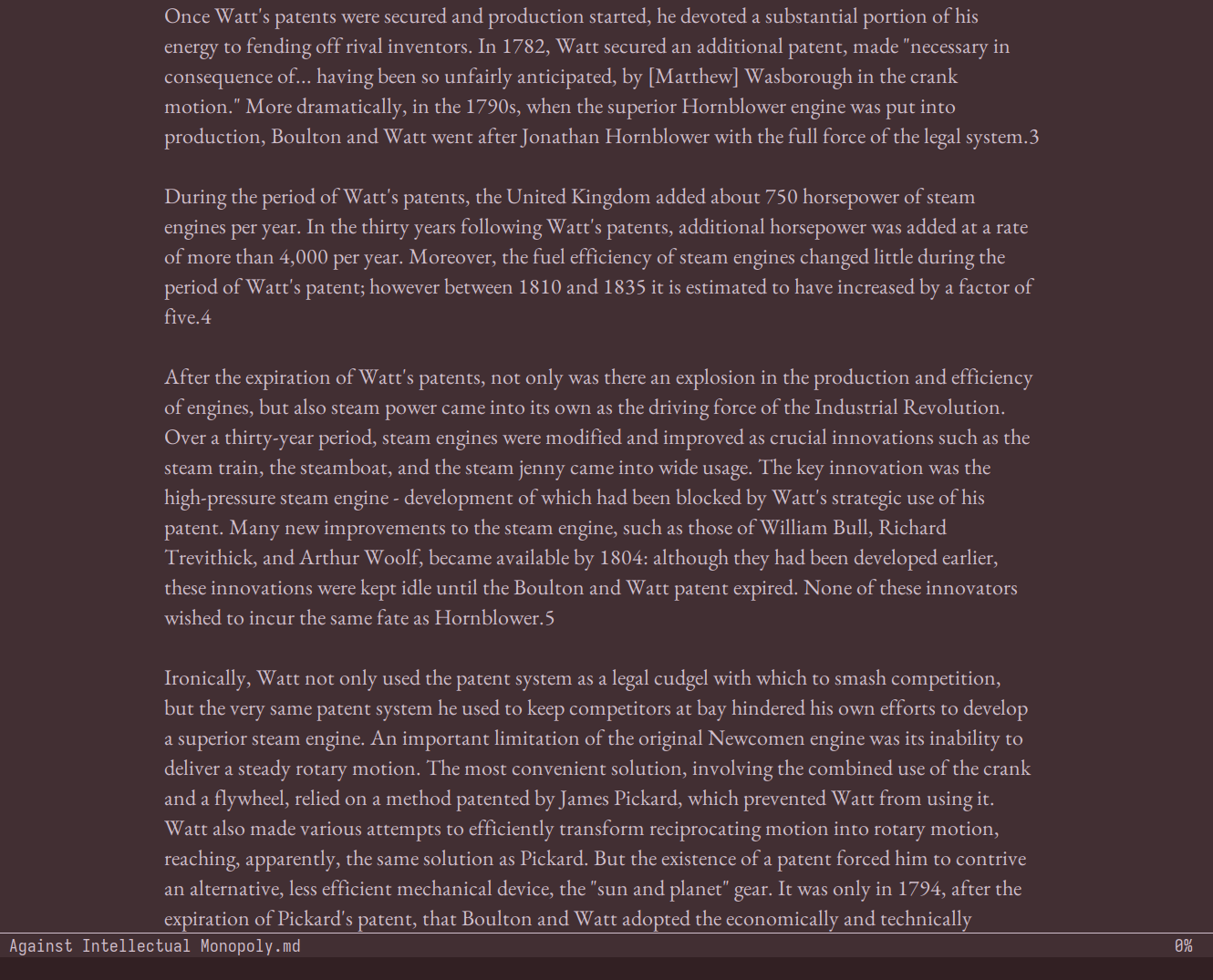
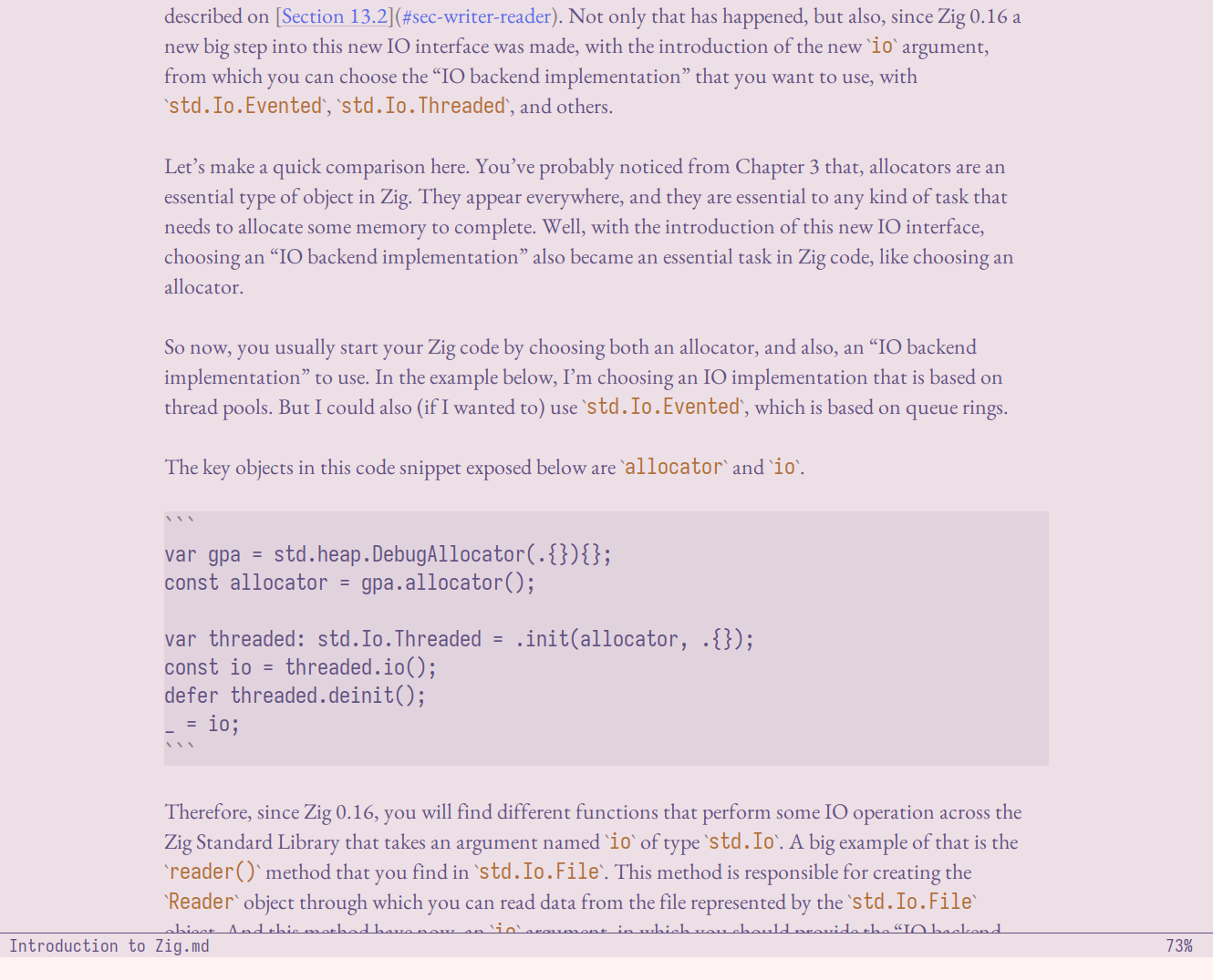
I'm also getting a laptop when I visit the US, and I'm considering disabling my home wi-fi, so I have to leave the house to use the internet and get work done. I'm really sick of scrolling.
It's early days, so I'll have more reports coming.
Meditation
I had multiple meditation sessions where I felt like I was bumping up against the bottom boundary of the jhanas (up from one last month, and none the month before). So that's really exciting in a sense, but jhanas are elusive, and wanting them disqualifies you from achieving them. I really don't care that much if it happens though. I'm not putting much intellectual energy into my formal practice, but my sits have been mostly excellent, and my sati in daily life has been increasing as well. This relates a little bit with the section above, where I've been "rawdogging" many more moments in the day.
I just don't have much to say about meditation. It's incredibly important, but I'm not at a stage where analyzing is super necessary. I'm making gradual progress, but I don't know if the next milestone is a month or 5 years away (and I'm ok with that).
Tempeh
I made tempeh several times this month, I also made 2 batches of homemade starter culture. I've gained some great knowledge about the whole process, but I need to be better about writing it down. I'll get fresh starter culture when I visit the US.
Most importantly, I was able to eat a ton of tempeh :)
Art
I don't have much to reflect on, I didn't do a ton of art this month. It feels like there's a lot of latent energy there and I hope to do some cool projects soon. One thing I've been waiting on is getting a smaller sketchbook when I visit the US. I want to do more plein air, but my setup is just too crazy right now for that.
I did some quick studies of the chihuahua who lives at the local lingerie store, Miguelito. I've promised the owner I'll do a more complete version at some point, so there's that.
New Sprint Framework (WIP)
This is my new strategy for managing multiple creative pursuits on a flexible schedule. Rather than try to do all of my hobbies at once, I hyper-focus on time-boxed projects one at a time, and rotate projects.
Sprints are designed to subvert or reverse some of the habitual assumptions around goal and project planning. First of all, sprints are strict constraints on projects. When the sprint is over, work on the project must stop; the next sprint will be a different project. Sprint deadlines are never moved, instead, I cut the project scope and ship whatever I can. Finally, I use appetite (how much time I am willing to spend) to set sprint length, rather than estimate how long the project will take. In this way, sprint planning leads projects, rather than the other way around.
The idea of this system is to break out of some common failure modes, keep each hobby fresh and interesting, and regularly ship imperfect work.
This is the latest of many attempts at a sustainable system. This time, I am trying to target the following issues:
- logging hundreds of hours of work but not actually shipping anything
- endless tweaking and redesigning, perfectionism, or scope creep
- when the original project turns out to be way harder than expected and seems impossible to finish, or doesn't make sense with new information
- projects drag on, hobby gets boring, lose motivation
- spreading myself too thinly across multiple hobbies every day, never getting my teeth into anything, not enough momentum on any one project or hobby
Sprint Planning Template
Goal Statement: [Write the high-level goal here]
Scheduling
- Start Date:
- Appetite: [e.g., 5 days]
- End Date: [calculated based on Appetite]
- Midpoint: [halfway between start date and end date]
Note on appetite: Do not estimate how long the project will take; instead, think about the value of having the finished project, and set the appetite as the maximum time you are willing to trade for that payoff. (If unsure, default to one week).
Scope
- Must Have: [What is the minimum requirement to meet the goal?]
- Nice to Have: [Part of the goal, but can be removed from scope if needed]
Reminder: Scope is variable, time is fixed.
- Deliverable: [Specify the ritual for closing and publishing the sprint outcome]
- Unknowns & Rabbit Holes: [List technical hurdles or perfectionism traps to watch out for]
Sprint Guide
After planning the sprint, list the 6 most important tasks to do next in order of importance. Then, each day do at least two 90 minute deep work sessions. Start with the first task, work on one task at a time, and don't multitask. At the end of the day, write a new list for the next day.
When you reach the midpoint date, objectively assess your progress. If you are behind, do not move the deadline. Instead, cut the scope.
When the end date comes, no more working on the project. Instead, produce the deliverable and plan a new project. The next project cannot be a direct continuation of the sprint that was just finished. Ideally, it should be a different hobby. The deliverable should not be a multi-day writeup. It must be finished on that day (even if it's just a paragraph blog post explaining what was done).
Appendix
sprint planning
Question to ask myself: what project, if I could complete it in a compressed/accelerated time frame, would be the most exciting and interesting to me right now?
NOT, the most achievable, the lowest hanging fruit, the most "realistic", etc. Forget about achievability temporarily to make the list.