This was a really great read for me. It’s basically the pop science presentation of the selectorate theory of democracy.
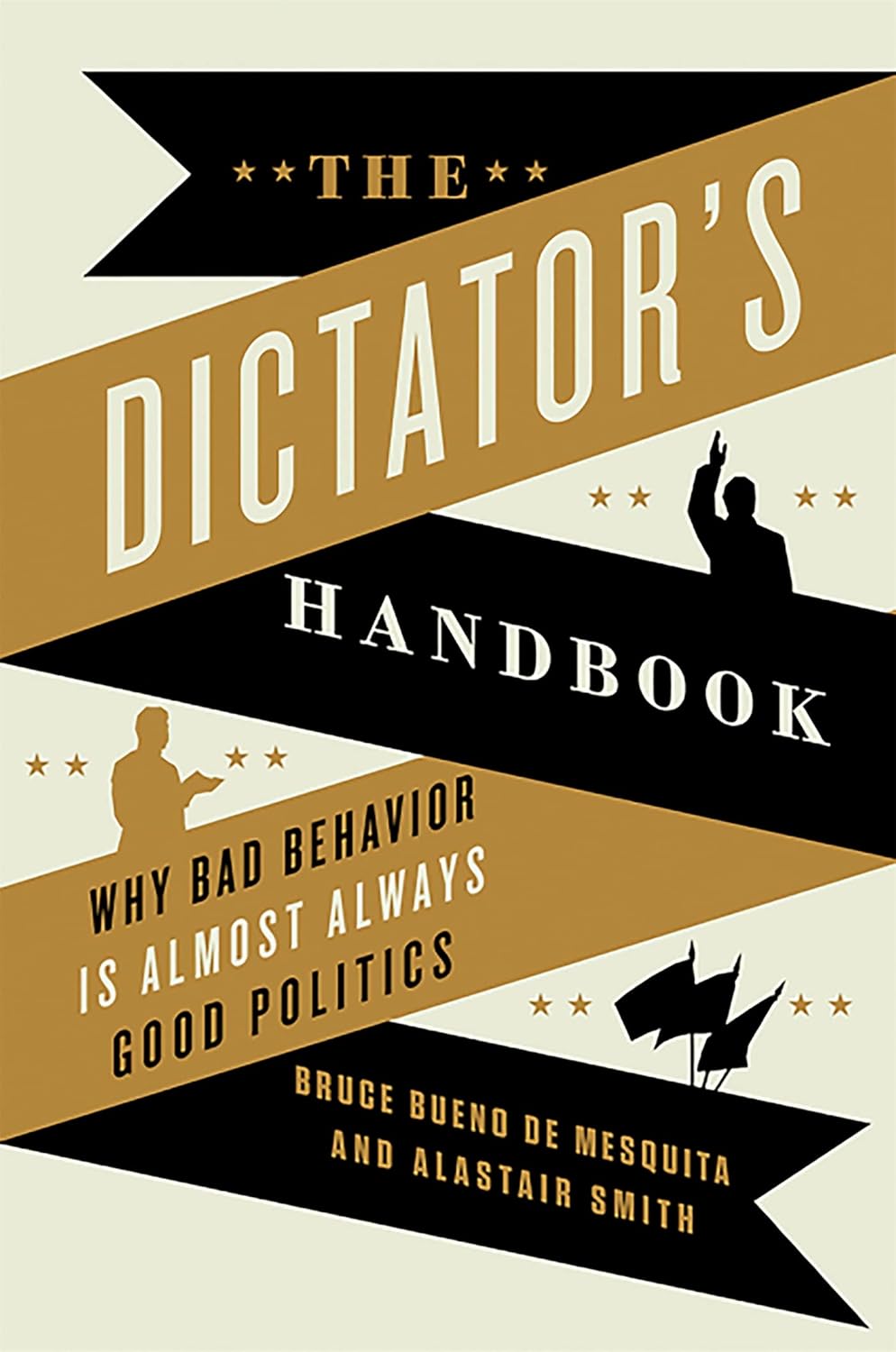
I read the book last year and its ideas are still bouncing around my head. I actually wanted to write a longer analysis/response to the book, but I realized it would be one of those pieces that I could spend an infinite amount of time writing and never be satisfied with.
So instead, I’ll just fire off some notes I took while reading.
Disclaimer
I haven’t studied political science. I’m speaking from personal experience here, as a regular person working through these issues. I’m not trying to make any sort of political argument about current events or politicians.First of all, selectorate theory makes sense to me, with some caveats and a general sense that it’s incomplete.
Lately, discourse around Democracy™ has been ringing hollow for me, and I’m not alone. Democracy is notoriously fiddly to even define. Most people resort to rattling off a list of complementary systemic features (rule of law, checks and balances, peaceful transfer of power, free press, minority rights…); we can call call these “purity checklists”. A lot of theories of democracy are compressed purity checklists. Another alternative is a vague cliché like “government by and for the people”.
We are taught to intuitively place states on a spectrum between Democracy™ and Authoritarianism™, with the former being inherently and tautologically superior (most authoritarian states masquerade as democracies, after all). We’re told not to worry; it’s only natural that political scientists can’t agree on what a democracy even is.
The Dictator’s Handbook strikes me as different because they throw out the ranked, weighted purity checklists completely.
The argument against the purity checklists is simple: they have no explanatory power for the rise and fall of democracies! Sure, they do an ok job of describing democracies, but they don’t really explain why democratization happens, or reverses, or doesn’t happen. And as political actors, shouldn’t we try to increase (or at least preserve) democracy?1
One of the implicit claims of the book is that selectorate theory explains the cause of democracy, while traditional models only explain effects or features of democracies.
Traditional models of democracy
I can’t evaluate and compare every theory of democracy to selectorate theory right now. But I do have an anecdote.
Around the same time I was reading The Dictator’s Handbook, my girlfriend was trying in vain to gain traction on Democracies and Dictatorships in Latin America: Emergence, Survival, and Fall .
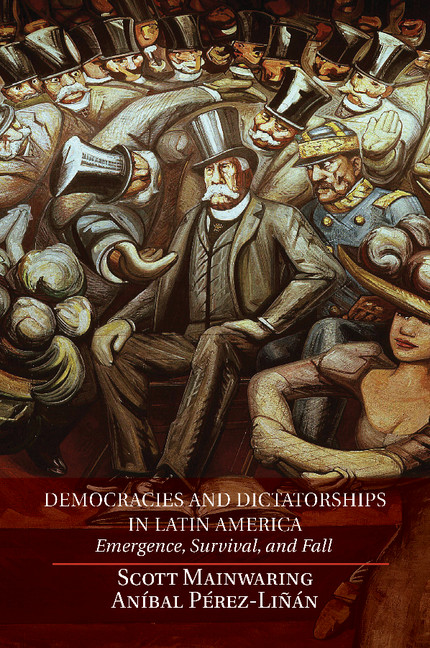
It’s written in academic language that’s harder to read, but surely somewhere in those 350 pages they try to explain what systemic factors cause democracy, right?
In Chapter 2: A Theory of Regime Survival and Fall, they present five hypothesized factors of democratic transition/detransition. I put a summary of the chapter below, which you can expand and read if you’re interested.
Click to view a summary of the chapter
The basic framework can be summarized as follows:
Regimes survive when the coalition of powerful actors supports the regime. They fall when a sufficiently powerful opposing coalition emerges. Democratic and authoritarian coalitions compete for the regime outcome, with their power determined by their resources (such as money, armes, votes, and public opinion).
5 Assumptions behind their theory:
- Purposeful actors in pursuit of their interests determine regime outcomes.
- In the era of mass politics, organizations such as political parties, militaries, labor unions and confederations, business associations, guerrilla groups, organized social movements, and heads of government are the most important actors.
- Most actors are interested in a range of policy considerations, and some also have strong independent normative preferences regarding the political regime.
- Actors’ normative attitudes about political regimes or their policy moderation radicalism cannot be reduced to their structural position in society.
- Powerful organizations create some path dependence in political systems in policy moderation/radicalism and normative preferences about the political regime, but countries and individual actors can break from this path dependence.
The 5 hypotheses they present:
-
H1: Radical actors increase the risk of breakdown of a competitive (democratic) regime. Radicalism (intense policy preferences combined with urgency and intransigence) undermines democratic compromise.
-
H2: A normative commitment to an incumbent authoritarian regime among the main political actors reduces the probability of a democratic transition. When powerful actors intrinsically value dictatorship (or loyalty to a dictatorial leader), they resist democratization.
-
H3: A normative commitment to democracy among the main political actors reduces the likelihood of democratic breakdown. Actors who value democracy intrinsically are willing to accept policy losses to preserve the regime, creating a “reservoir of support” that sustains democracy through hard times. Conversely, absence of normative commitment to democracy makes breakdown more likely.
-
H4: Strong international support for democracy increases the probability of democratic transitions. International actors influence domestic outcomes through diffusion of beliefs, demonstration effects, incentives and sanctions, resource allocation to domestic actors, dual domestic-international roles (e.g., the Catholic Church), and direct intervention.
-
H5: Strong international support for democracy reduces the risk of democratic breakdowns. A democratic regional environment and international pressures stabilize existing democracies. Conversely, weak international support for democracy raises the odds of breakdown.
But what’s my actual point here? I conclude that shockingly, the authors simply do not know what causes democracy. Their hypotheses are a collection of additional variables that expand on the traditional purity checklist. But if you read between the lines, they all pretty much mean “democracy happens (or doesn’t happen) when the right combination of people want it to happen”. Basically, it’s random. A messy petri dish where democracy sometimes happens, and sometimes one of the above variables seems to correlate.
Modeling Democracy
So anyway, back to The Dictator’s Handbook. I think of this book as a real-world psychohistory attempt. It presents a mathematical model for democracy and authoritarianism. They tie the model together in the final chapter. This graph is probably the best direct illustration of the inflection point between democracy and authoritarianism:
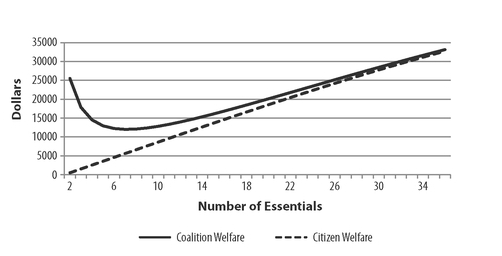
There’s actually a tipping point where it becomes rational for coalitions to provide public goods and expand membership, even at the cost of smaller private gains. If that makes no sense to you, read the book!
Some Final Notes
Chapter 7 completely reversed my position on foreign aid.2 Well worth the read, even if just for that chapter.
The book has some major issues with its delivery. It’s sometimes padded with too many examples; it overestimates its own controversy; it has anachronisms from 2011; and it has a bit of hindsight bias.
My biggest issue is just a sense of incompleteness to the theory. Where does power come from?
Still, it’s a great read. It gave me new mental models for thinking about power and incentives in democracy.
If you don’t have the attention span for the book, there’s a two part YouTube series you can watch – but it doesn’t cover some of the most important parts.
-
(The answer is axiomatically “yes”, by the way. If you have a conflict of interest that causes you to say no, you are axiomatically my enemy, or you have an interesting take I’d like to hear.) ↩︎
-
For example, take the following statement about foreign aid: Foreign aid helps reduce suffering and support development in poorer countries, and it also advances the donor’s own interests by encouraging stability and long-term prosperity abroad. In that sense, foreign aid is not just a moral duty but a practical investment. Chapter 7 basically obliterates this rhetoric. I’ll leave it to you to read the chapter. ↩︎